logo

IPON Research Network

Mentorship

Program Overview

The International Indigenous Mentorship Program (IIMP) sought to strengthen cultural identity and practical research skills of Indigenous and non-Indigenous young researchers associated with IPON network. The emphasis was on Indigenous Knowledge and experiences, and connections between food, health and well-being in context of climate change.

The program was funded by ESRC Impact Acceleration Account of University of Leeds.

Participants

Participants map
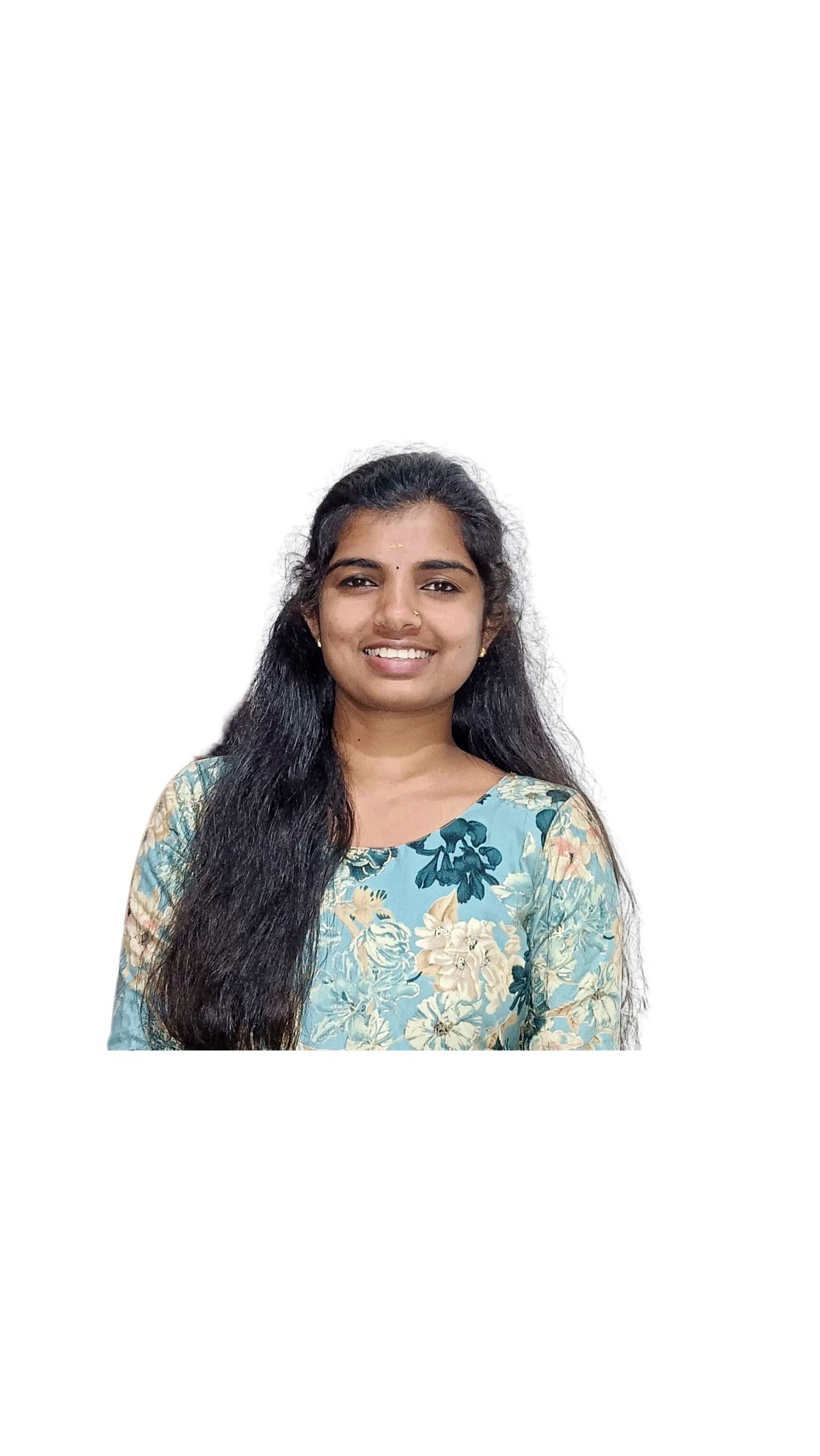
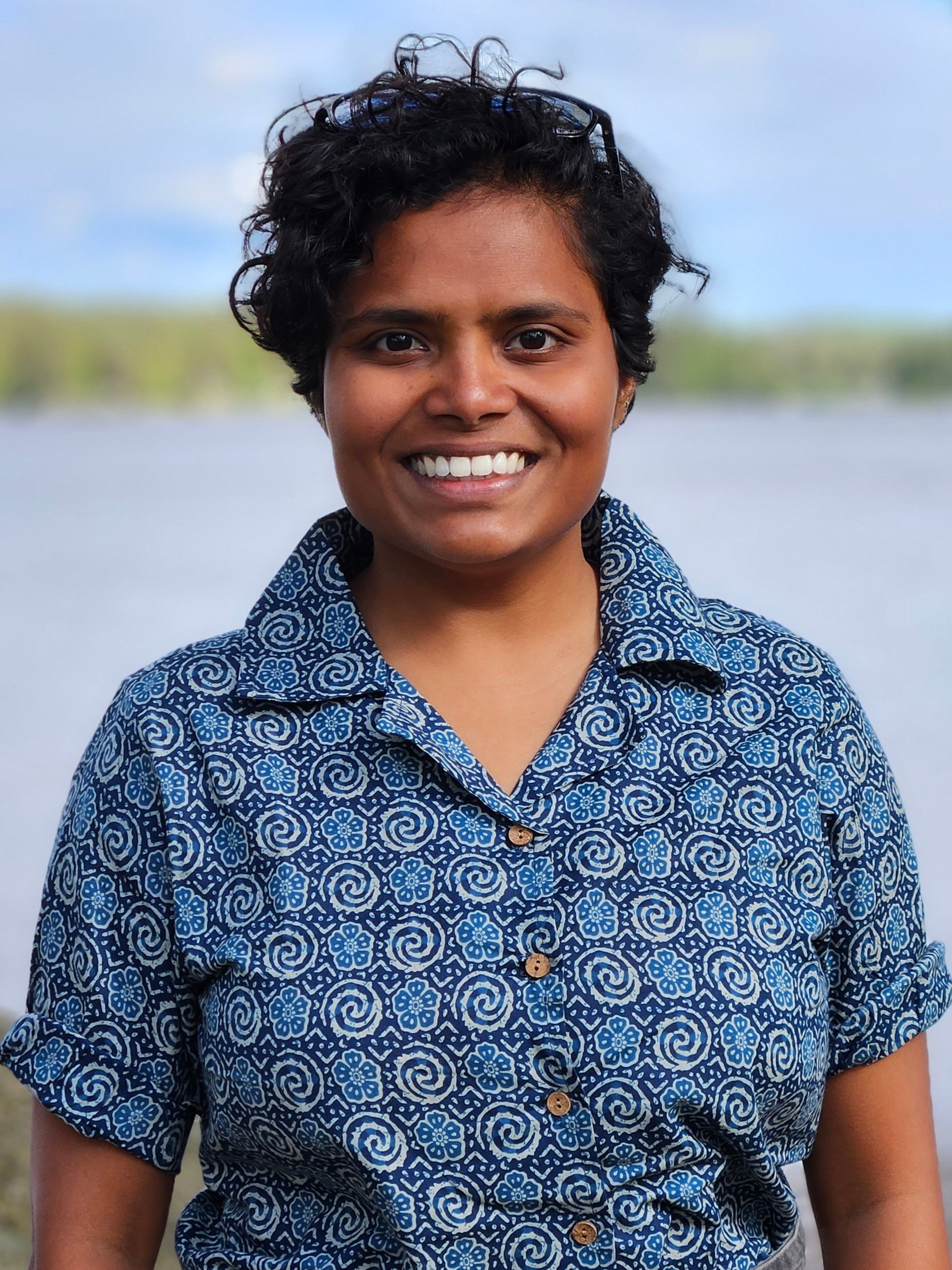
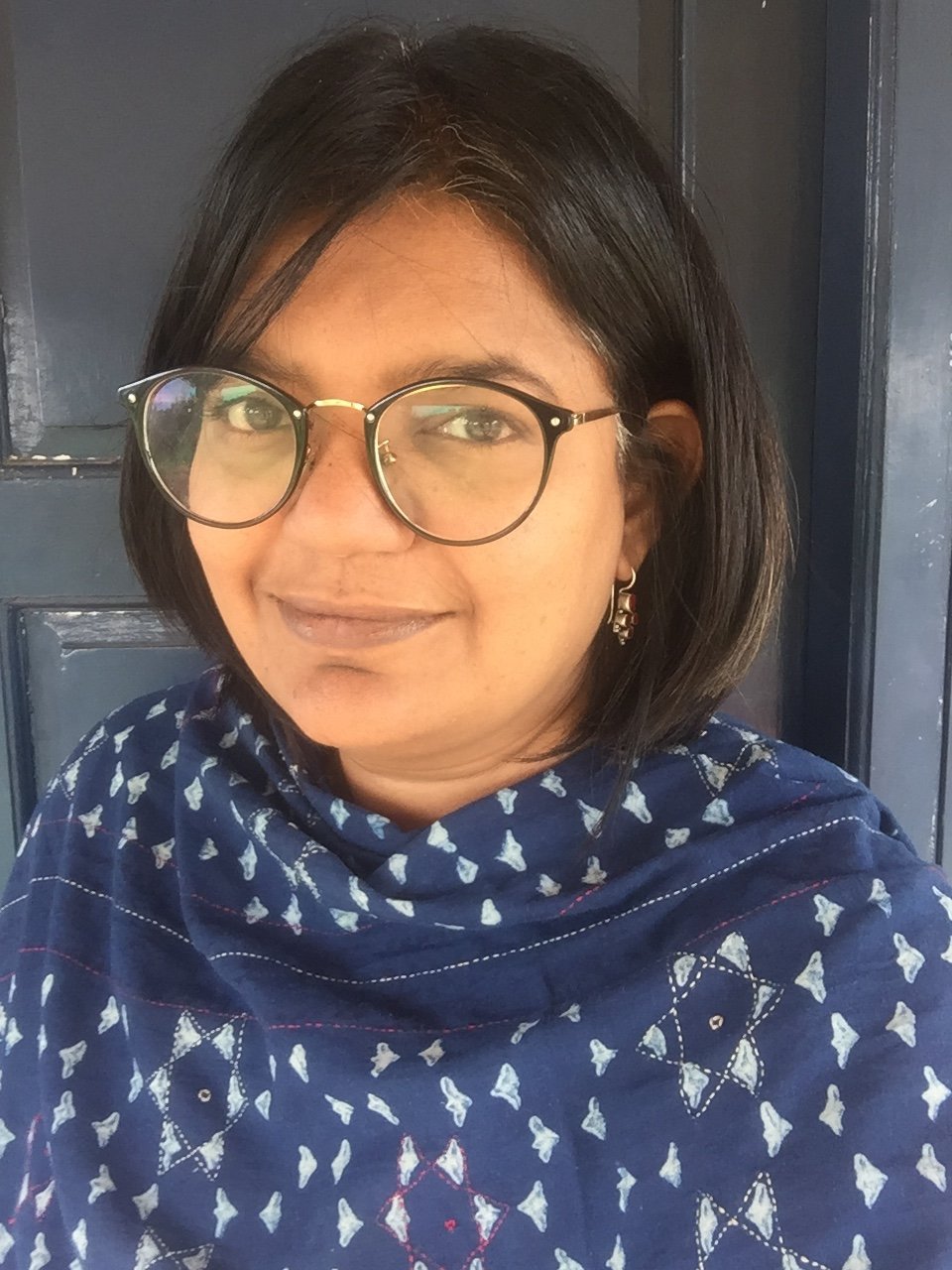
Khavyanjali K

Khavyanjali K

Wayanad, Kerala, India

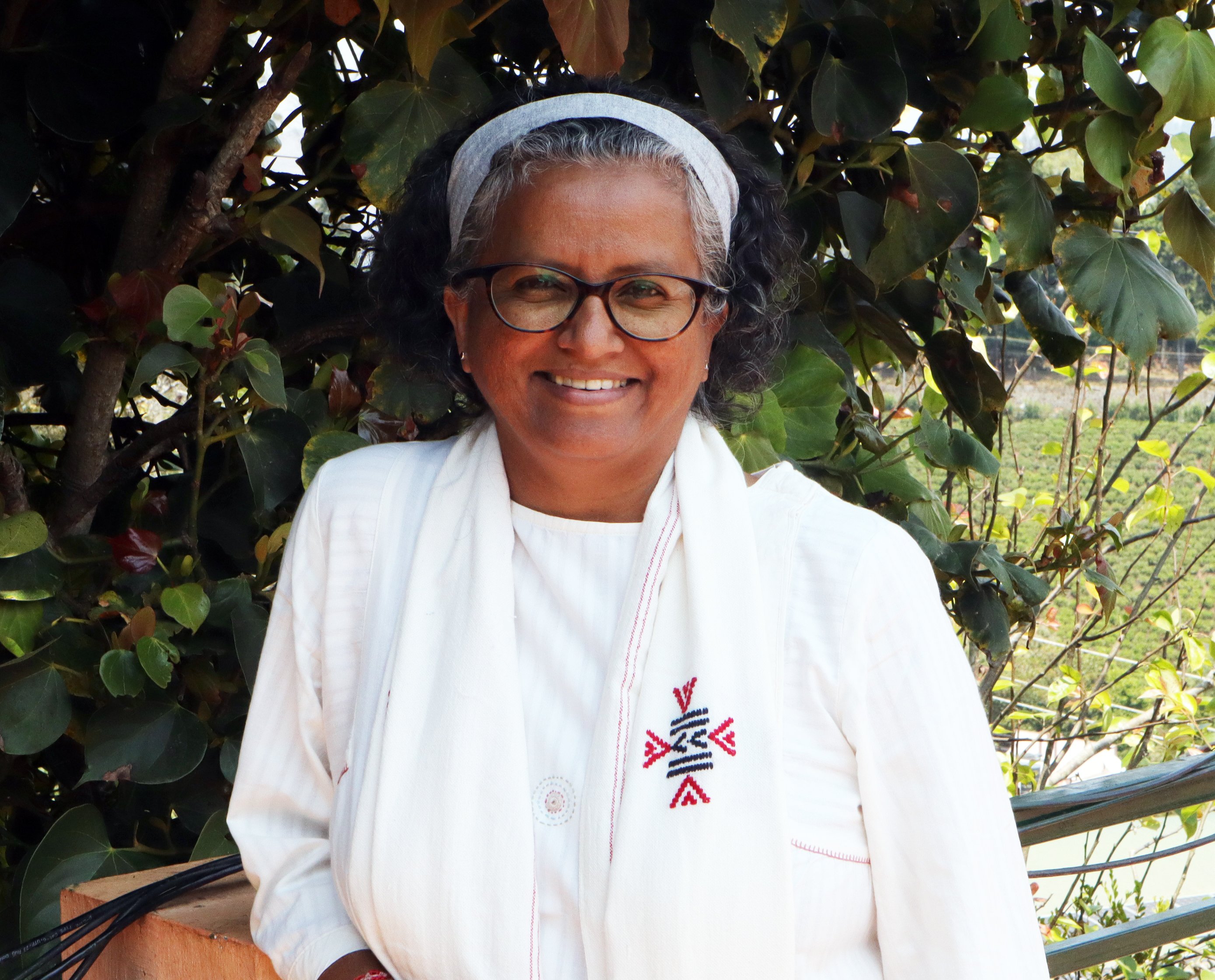
Hailing from Wayanad, Kerala, India. I belong to the Kurichya indigenous community, known for our agricultural and hunting traditions. I've worked extensively with my community as a librarian at Gothradeepam, a tribal library, and as a coordinator for Keystone Foundation's Community Leadership Programme. My advocacy focuses on indigenous language revitalization, cultural heritage, and sustainable agriculture.

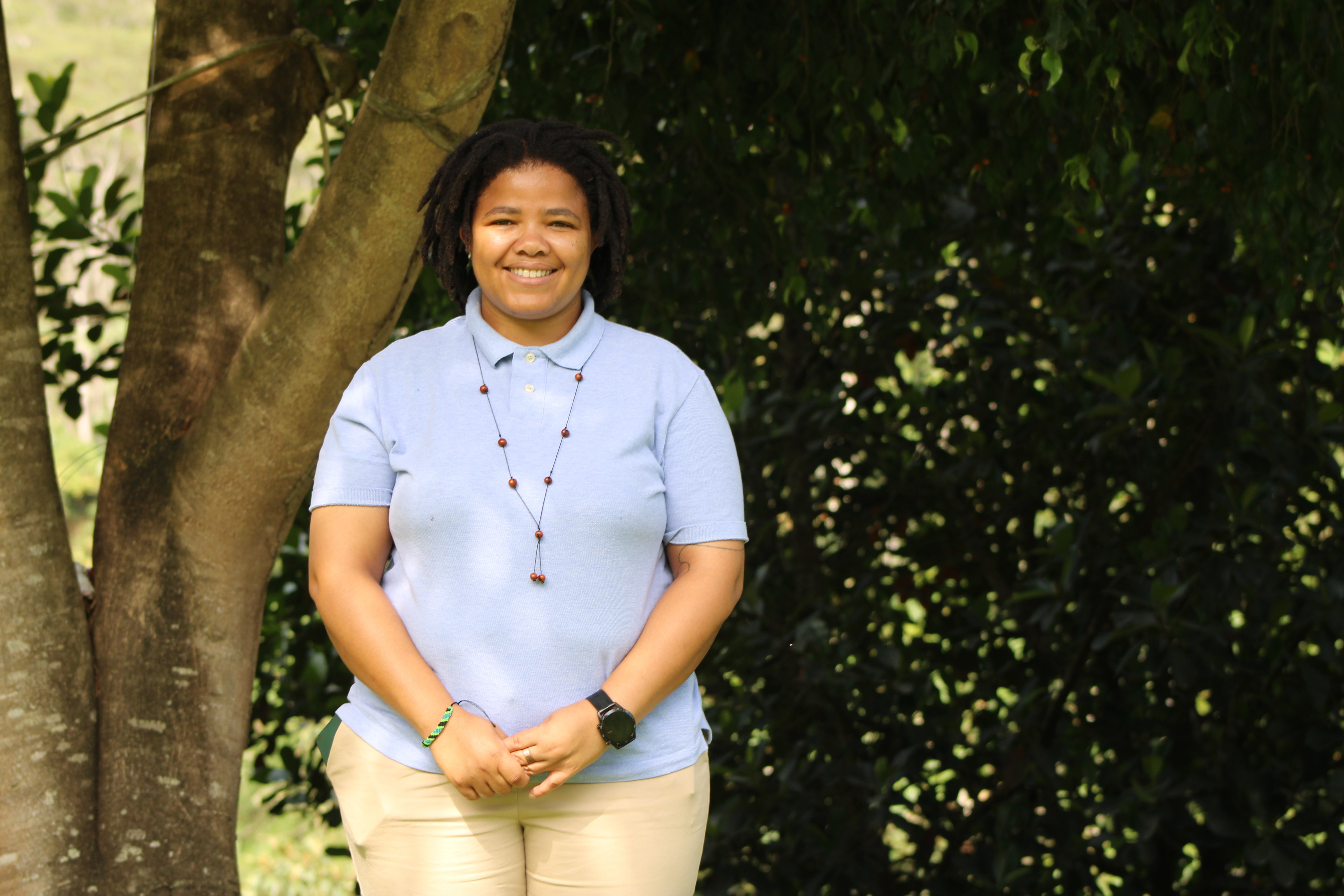
Vasiti Tebamare

Vasiti Tebamare

Kiribati

President of the Kiribati Health Retreat Association where she advocates for wellness and holistic health within the community. As a member of the Kiribati Climate Action Network, she works to address climate change challenges emphasizing the link between environmental sustainability and public health.

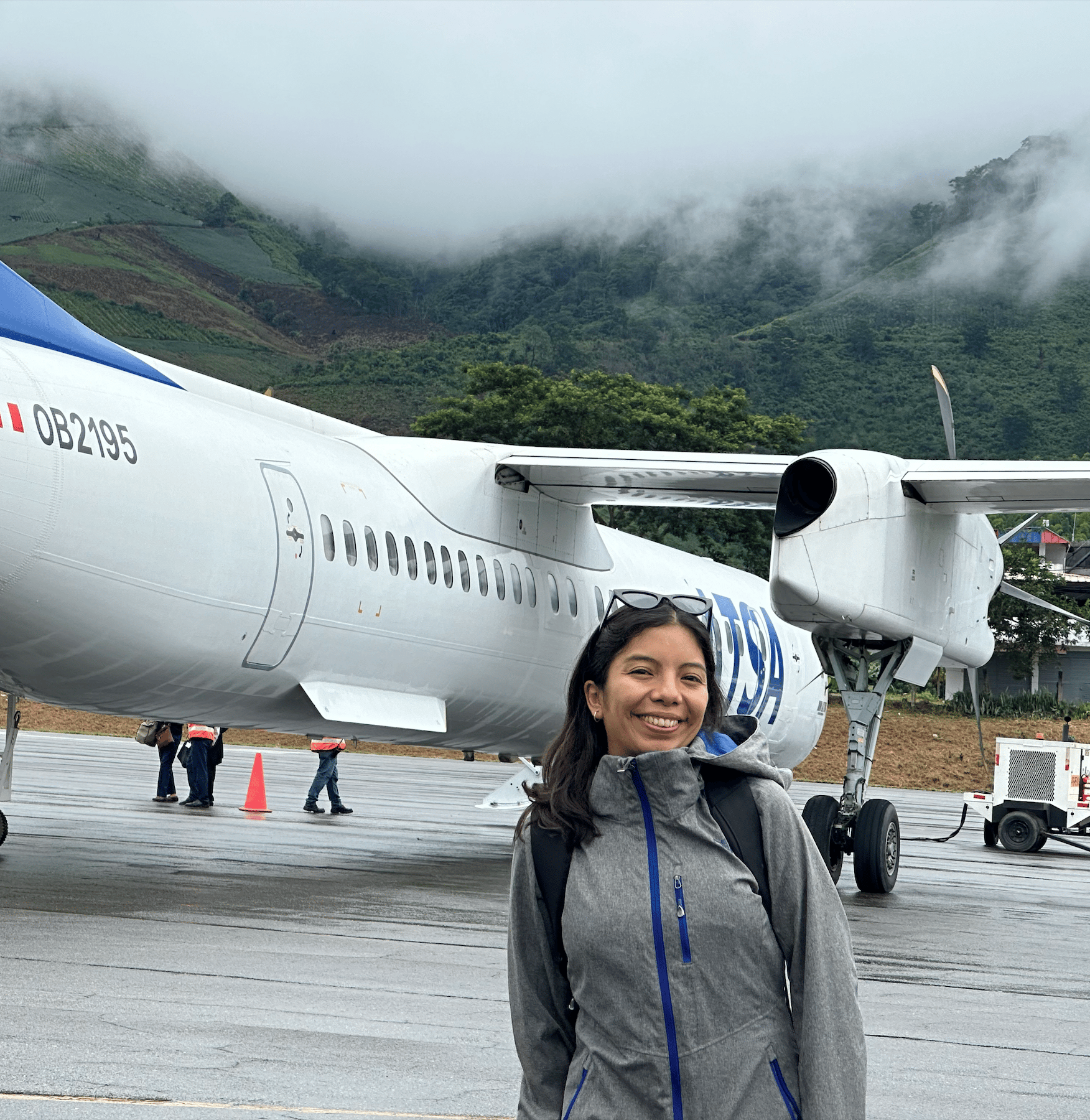
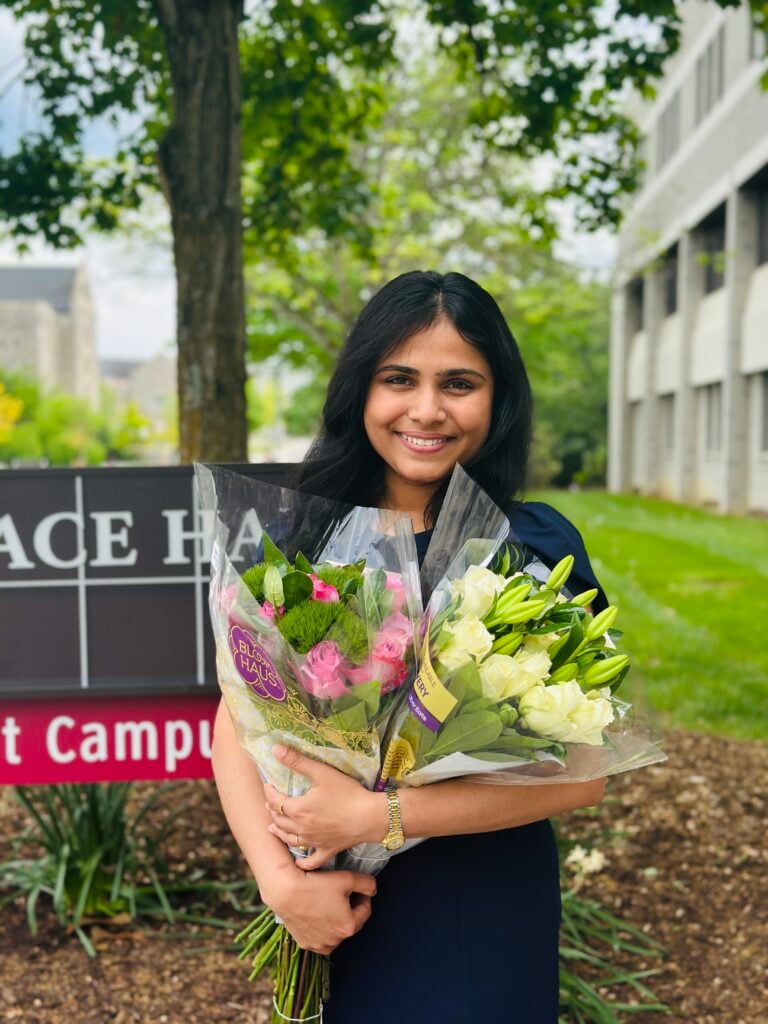
Andrea Valdivia

Andrea Valdivia

Perú

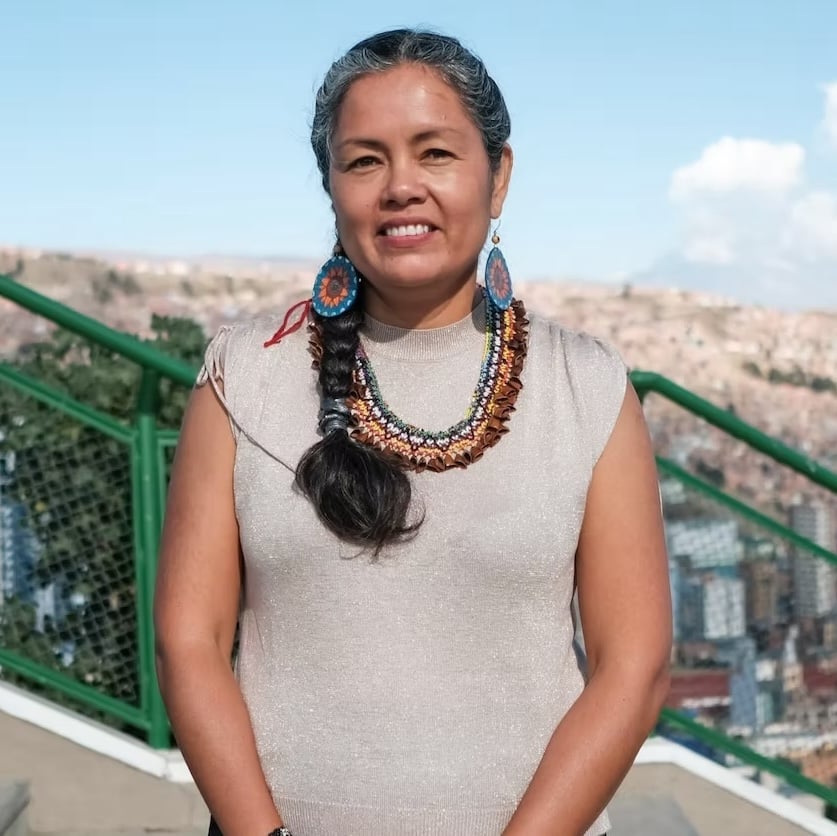
I'm from the north of Peru, and my background is in nutrition and sustainable food systems. Over the past few years, I've been involved in research projects that connect climate change, Indigenous health, and food systems, mostly working alongside communities in the Peruvian Amazon.

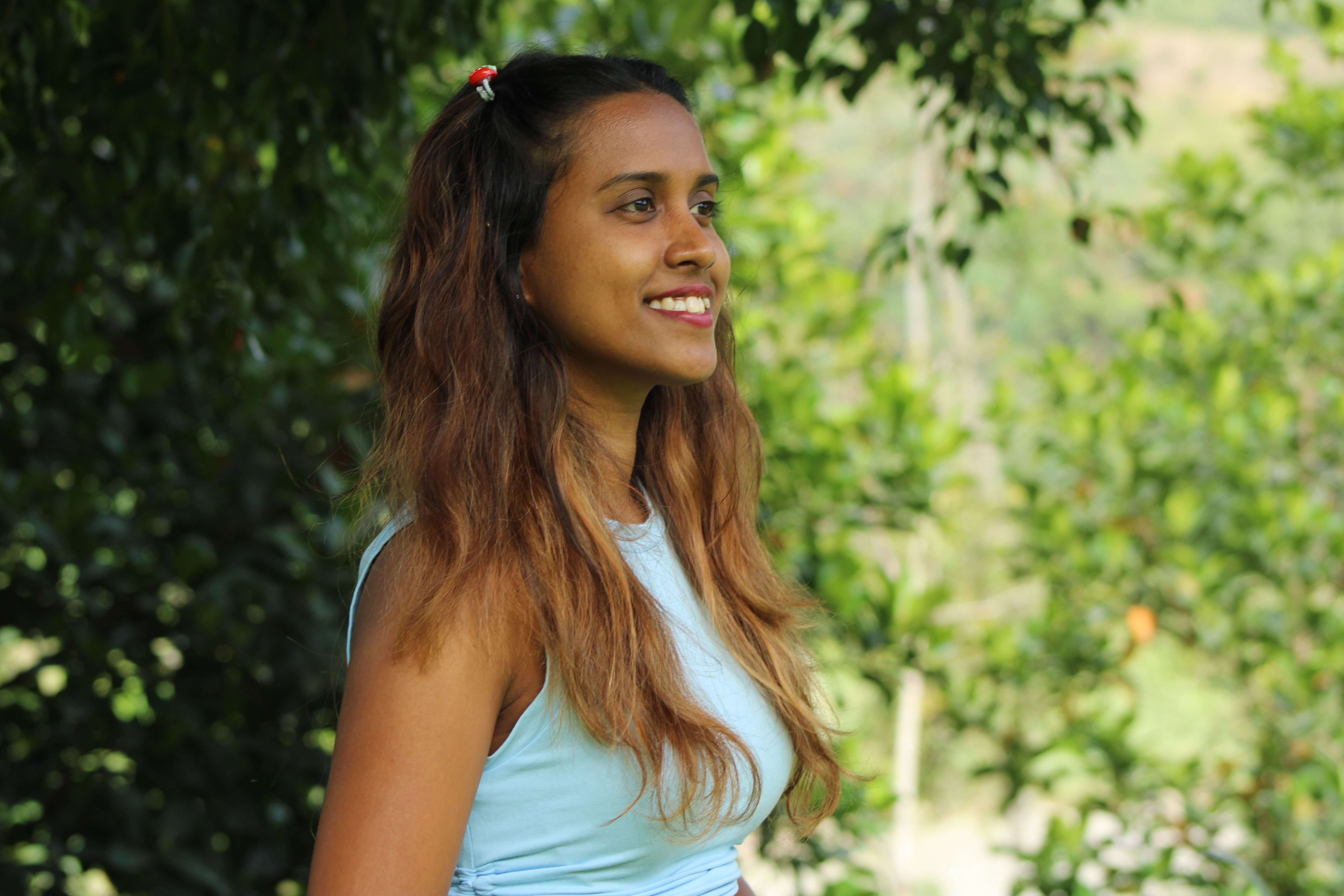
Gauri Salunkhe

Gauri Salunkhe

Fiji

Budding researcher with a Master's in Sustainable Technology from KTH Royal Institute of Technology. Born in India, brought up in Singapore, and having completed her Master's in Sweden, she brings multicultural perspectives. Gauri has extensive experience in participatory research methods with transdisciplinary teams.

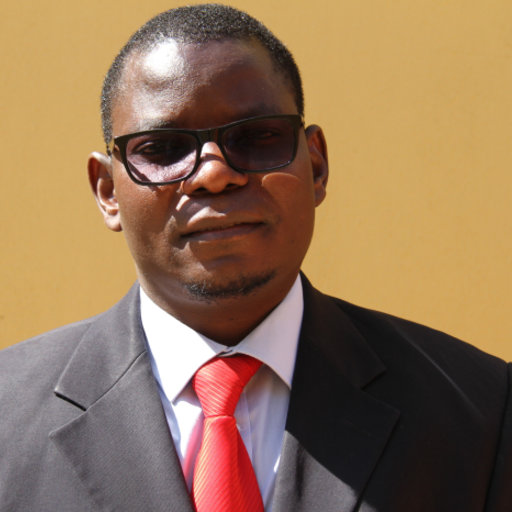
Nosipho Mwaisango

Nosipho Mwaisango

Ghana

Born in Nandom in the Upper West Region of Ghana. I did my primary schooling in Nandom and continued Junior Secondary school and Senior Secondary school in Tamale-Northern Region. As an Agriculture Extension Agent (AEA), I'm currently working with the Department of Agriculture in Nandom Municipal.

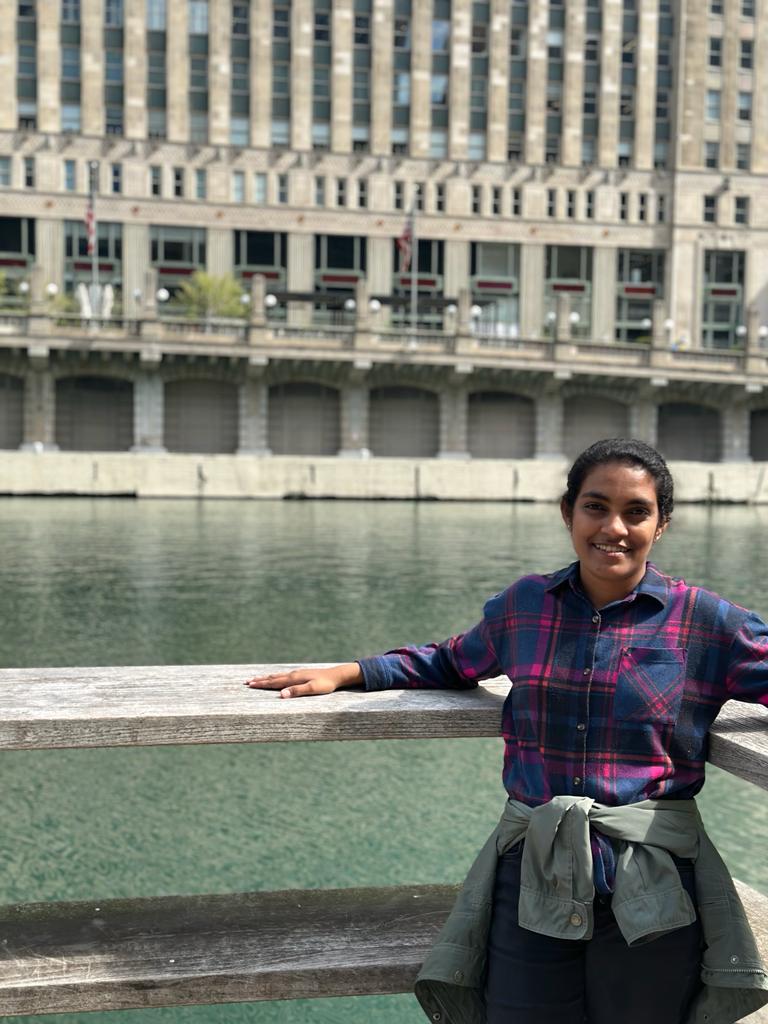
Sithuni Mimasha

Sithuni Mimasha

Sri Lanka

Sithuni Mimasha is a Geography Master's degree student at Virginia Polytechnic Institute and State University. She is originally from Sri Lanka. Sithuni focuses on topics related to Indigenous peoples, climate change, resilience, and food systems.

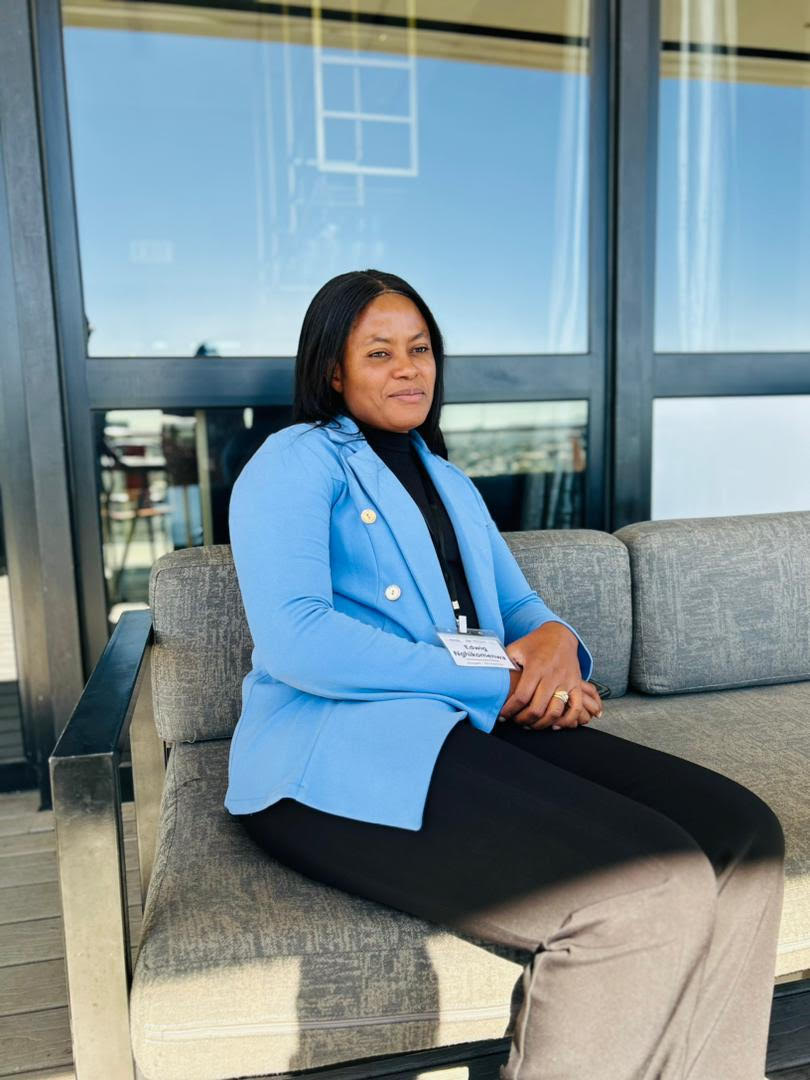
Edwig Nghikomenwa

Edwig Nghikomenwa

Namibia

Registered nurse by profession from Namibia, currently doing my masters of public health at the university of Namibia. In my years of experience as a nurse I have worked closely with indigenous communities (San) and lived closely with them at my village. My current job is a district quality manager working under i-tech Namibia.

Sessions

June 17 16:00 - 17:30 (GMT+2)

The contribution of Indigenous Knowledge to sustainability and global challenges

First group training
Carol Zavaleta Cortijo

Carol Zavaleta Cortijo

Medical surgeon and researcher in climate change, food security, intercultural health and the health of Indigenous populations. Her experience comes from her work as a primary healthcare physician in the Peruvian Amazon and her PhD in health geography in Canada. She is a member of international scientific committees including the Lancet Commission on Sustainable Health Care (LCSH), Global Environmental Outlook (GEO-7) of UNEP, and the Global Hub of Indigenous Peoples ́ Food Systems of FAO.

July 4 8:30 - 10:00 (GMT+2)

Community engagement, trust- building, and collaboration with Indigenous Peoples

Second group training
Anita Varghese

Anita Varghese

Director at Keystone Foundation, leading the Biodiversity Conservation, People and Nature Collectives programs and the Knowledge Hub. Her expertise lies in topics related to sustainable use, non-timber forest products, and long term population dynamics of harvested species, human wildlife interactions, invasive plants, and endangered trees. Her research has always been in partnership with Indigenous Peoples bringing to the fore the role of traditional ecological knowledge in biodiversity conservation.

July 14 15:00 - 16:30 (GMT+2)

Elements of scientific research: development of a research proposal and manuscript

Third group training
James Ford

James Ford

Professor and Chair in Climate Adaptation at the Priestley Centre for Climate Futures at the University of Leeds. His research focuses on climate change impacts, adaptation, and vulnerability. He works closely with Indigenous communities in the Arctic and globally, with a major focus on health, well-being and food security. He has served as a lead author on the IPCCs Special Report on 1.5C of warming, and has also served in the Scientific Advisory Group to UNEPs GEO-7 Assessment. He has published >300 peer reviewed articles and in 2021 he was ranked 49th in the Reuters Hot List

Sept 17 18:00 - 19:00 (GMT+2)

Leadership and networking to connect with decision-makers on international platforms

Sixth group training
Mikaila Way

Mikaila Way

Working at the FAO North America, she collaborates closely with Indigenous Peoples in the region, focusing on their food systems and related priorities within the FAO's mandate. Mikaila also works as part of the FAO Indigenous Peoples Unit as the international Indigenous Youth focal point. This work builds on her previous experience learning and working with Indigenous leaders and communities in the western part of the United States and Hawai’i.

Sept 12 15:00 - 16:30 (GMT+2)

Indigenous research methodologies, integrating Indigenous and scientific knowledge systems

Fifth group training
Yolanda Lopez Maldonado

Yolanda Lopez Maldonado

Indigenous earth systems scientist from a Maya community in Mexico. Her research focuses on the revival and recovery of Indigenous science to address complex Earth challenges. Holding a PhD in Human Geography she promotes Indigenous knowledge in international environmental frameworks. She founded Indigenous Science, an indigenous-led organization dedicated to integrating Indigenous science into global scientific and diplomatic efforts.

Sept 9 16:00 - 17:30 (GMT+2)

Research communication and dissemination to raise awareness

Kerrie Pickering

Kerrie Pickering

Postdoctoral Fellow at the School of Public Health, University of Alberta, and Research Associate in the Environmental Sustainability Research Centre, Brock University. Kerries' research focuses on the nexus of health, environmental sustainability, and food security in Indigenous communities from Fiji.

Andrea Hanke

Andrea Hanke

They is a social science researcher focused on knowledge accessibility and community-based research. They collaborated with Arctic Inuit communities for their PhD, and is skilled at communicating social science techniques to natural scientists. They is passionate about effective communication that achieves its intended purpose.

Mentors

Eranga Kokila Galappaththi

Eranga Kokila Galappaththi

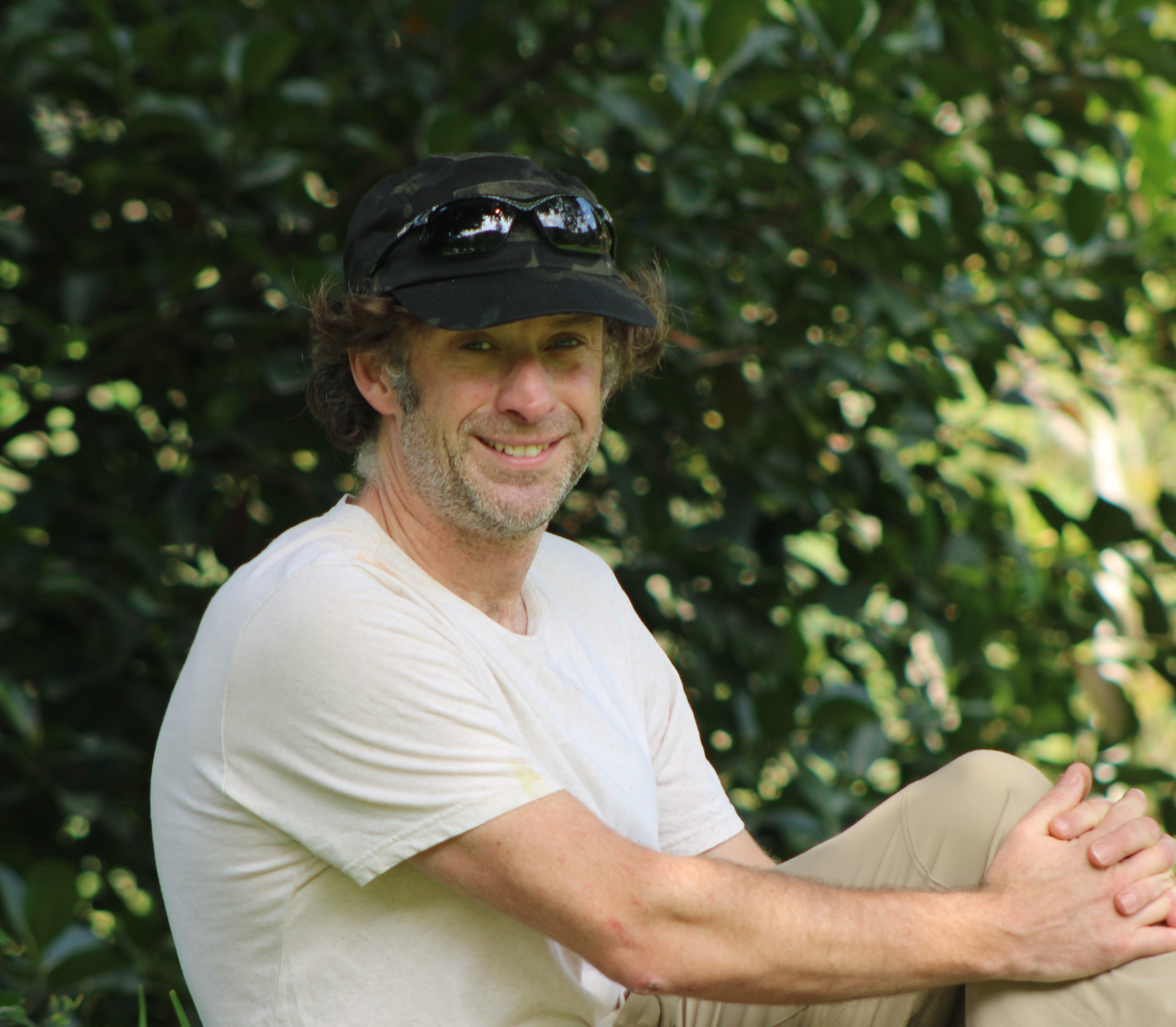
Professor Eranga Galappaththi is an Assistant Professor in the Department of Geography at Virginia Tech, USA. Eranga led Indigenous research in Sri Lanka. His research is focused on climate change adaptation in remote Indigenous communities and their local food systems.

Jyotsna Krishnakumar

Jyotsna Krishnakumar

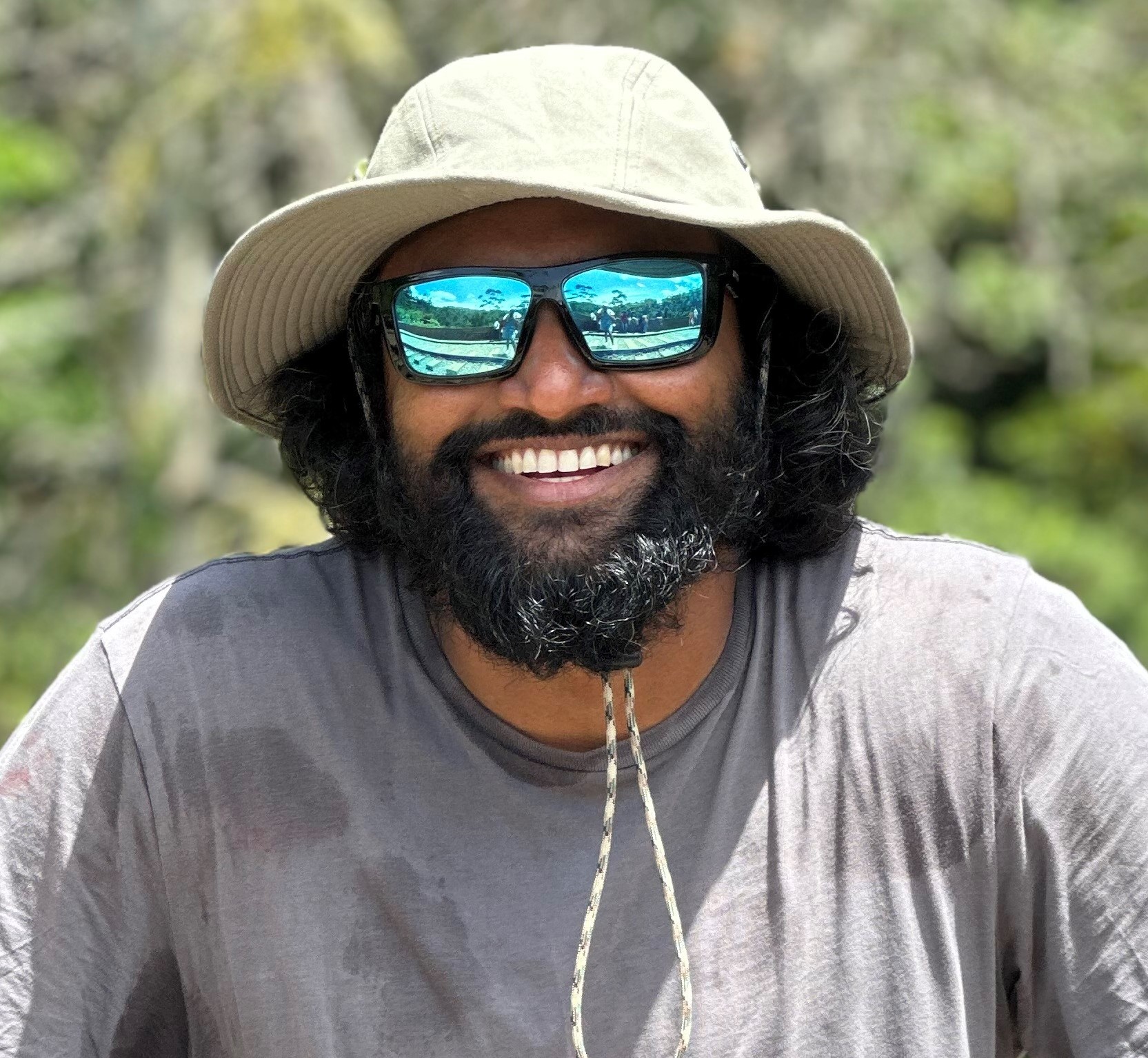
Dr. Jyotsna Krishnakumar is a Director at Keystone Foundation, where she manages multiple field implementation and research projects focusing on Indigenous well-being linked to traditional food systems, health, and wellness.

Chrishma Dharshani Perera

Chrishma Dharshani Perera

Chrishma Pereras a PhD Student in Geography and Environment at Western University,London, Ontario, Canada. She is from Sri Lanka. Chrishma is passionate about Climate Change, Indigenous Peoples, Health, Food Systems and Sustainability.

Cecil Togarepi

Cecil Togarepi

PhD Candidate, and MSc holder. Cecil Togarepi is a Lecturer at the University of Namibia with a background in Agricultural Economics. His interests are in agribusiness, agricultural development, value chain development, encroacher bush value addition, climate change adaptation, livelihood resilience, and food security.

Gayanthi Ilangarathna

Gayanthi Ilangarathna

She is an environmental social scientist interested in the intersections of food security, climate adaptation, resilience, and vulnerability, particularly within the contexts of smallholder farmers and Indigenous communities. Her research combines both qualitative and quantitative approaches, drawing on multidisciplinary collaborations across the social and environmental sciences. She has worked closely with smallholder farmers in rural Sri Lanka and with Inuit communities in the Canadian Arctic, experiences that continue to shape my understanding of how local knowledge, institutions, and socio-environmental dynamics influence adaptation and food system resilience.


Key Messages

Indigenous Peoples possess valuable, deep ecological knowledge that is essential for preserving ecosystems and human health, and addressing global challenges.

Collaborating with Indigenous Peoples requires trust-building processes and proper recognition and credit for their knowledge.

Mentorship efforts are needed to support Indigenous early-career researchers and to ensure research engaging Indigenous Peoples is ethical and fair.


Outcomes of the Mentees

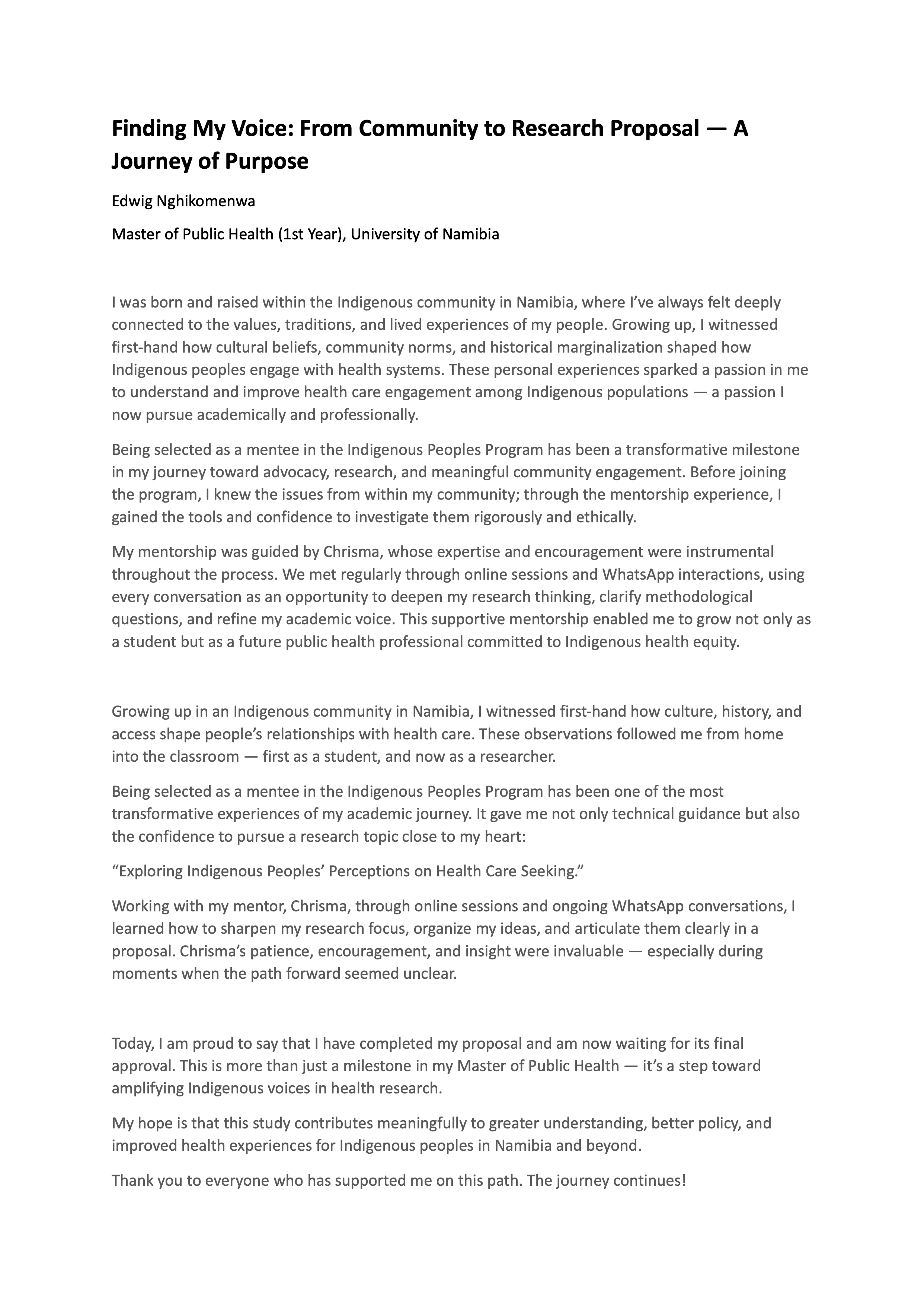
Final Outcome for Edwig Nghikomenwa

Final Outcome for Edwig Nghikomenwa

Final outcome document for Edwig Nghikomenwa from Namibia

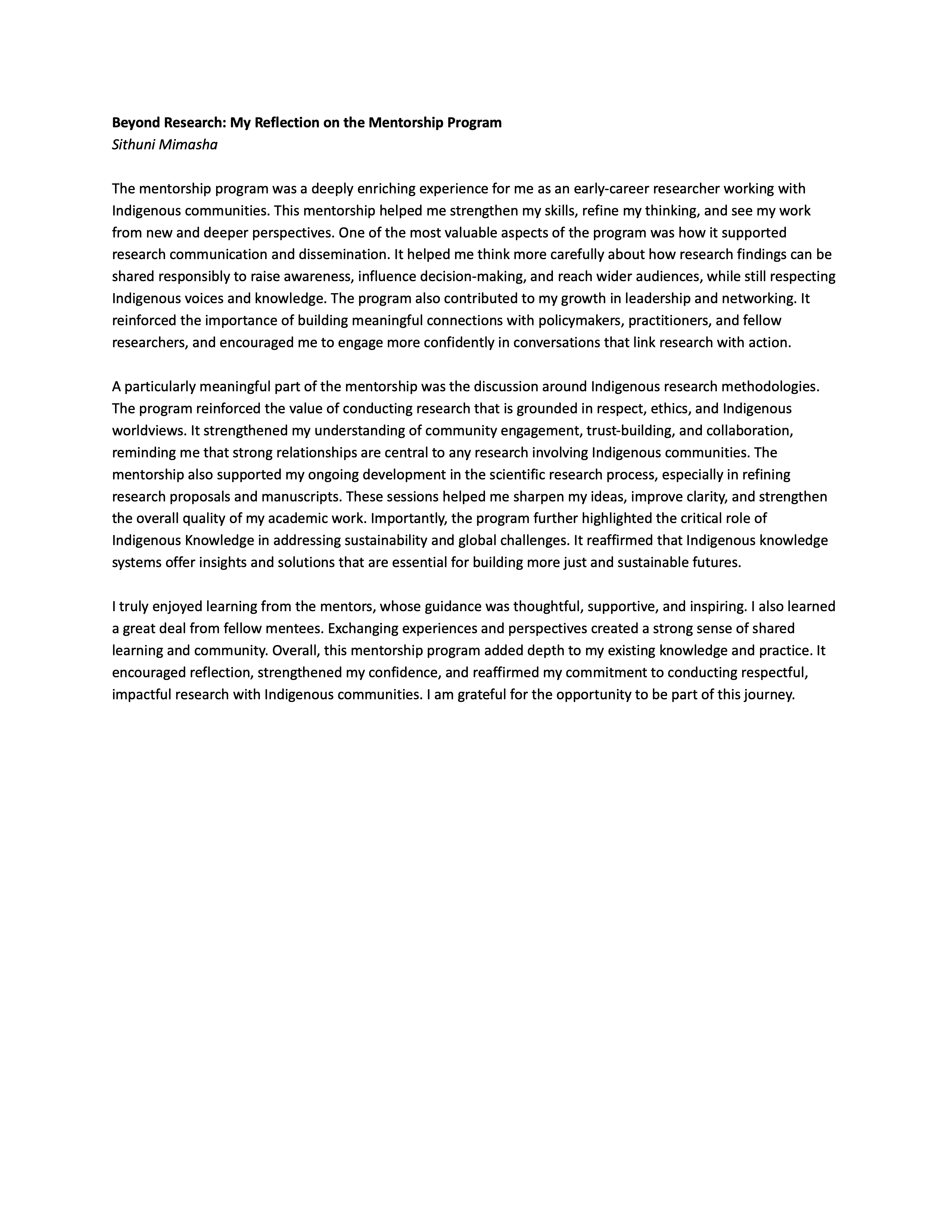
Mentorship Reflection - Sithuni Mimasha

Mentorship Reflection - Sithuni Mimasha

Mentorship reflection document from Sithuni Mimasha from Sri Lanka

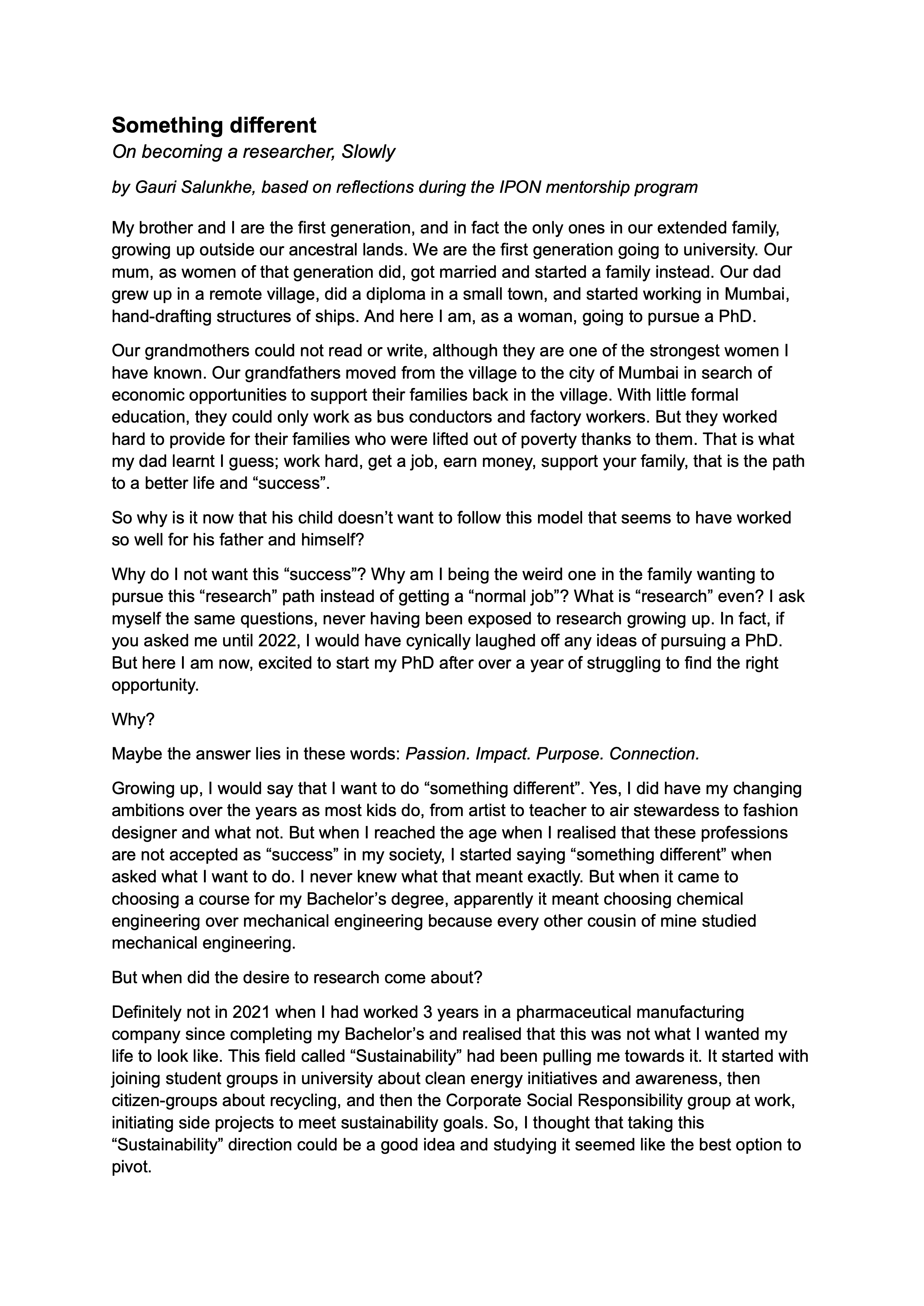
Mentorship Write Up - Gauri Salunkhe

Mentorship Write Up - Gauri Salunkhe

Mentorship write up document from Gauri Salunkhe from Fiji

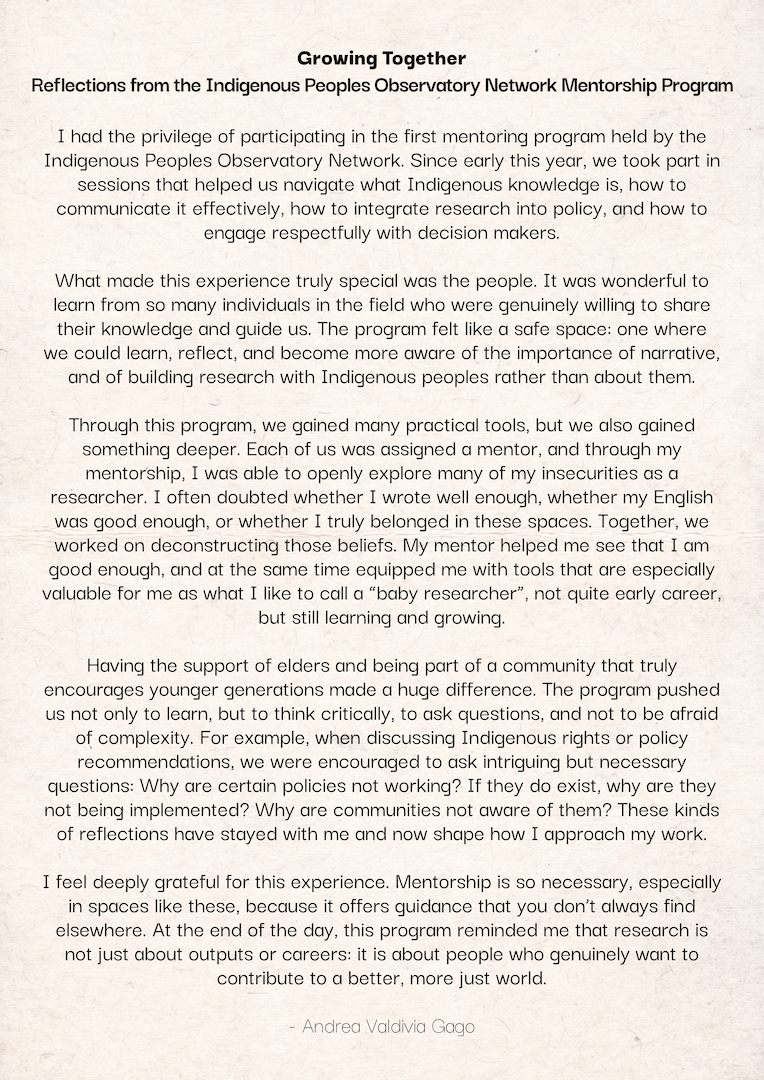
Reflections from the Indigenous Peoples Observatory Network Mentorship Program

Reflections from the Indigenous Peoples Observatory Network Mentorship Program

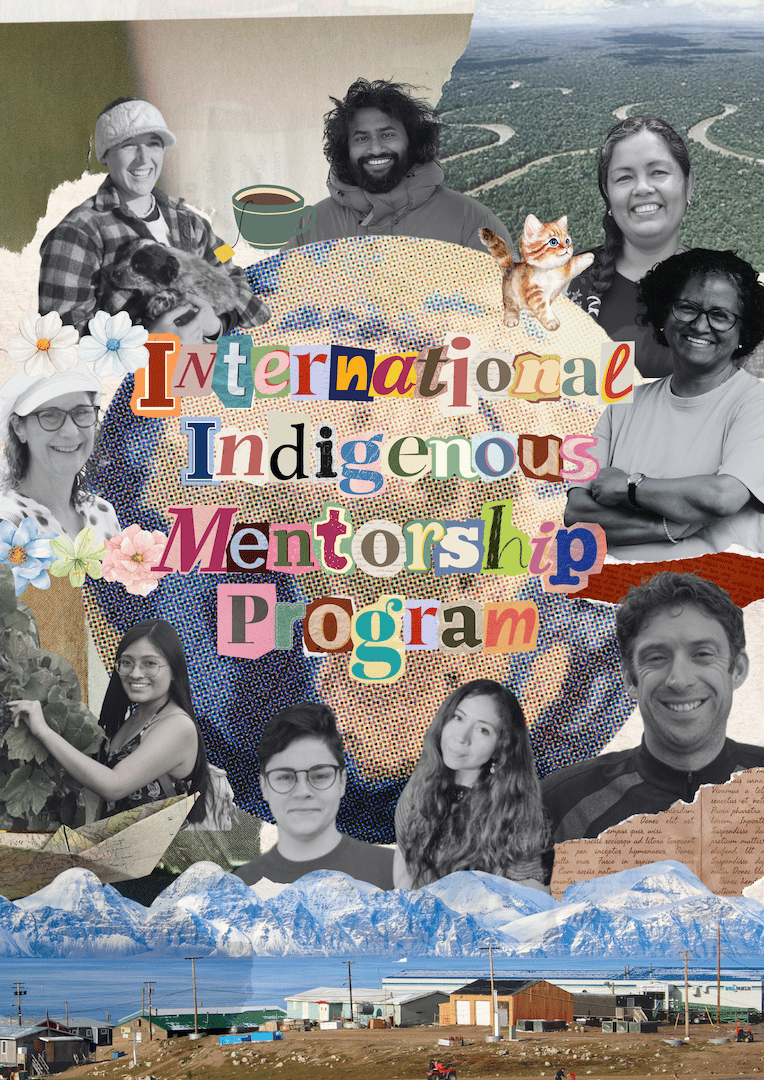
Andrea's Output Collage

Andrea's Output Collage

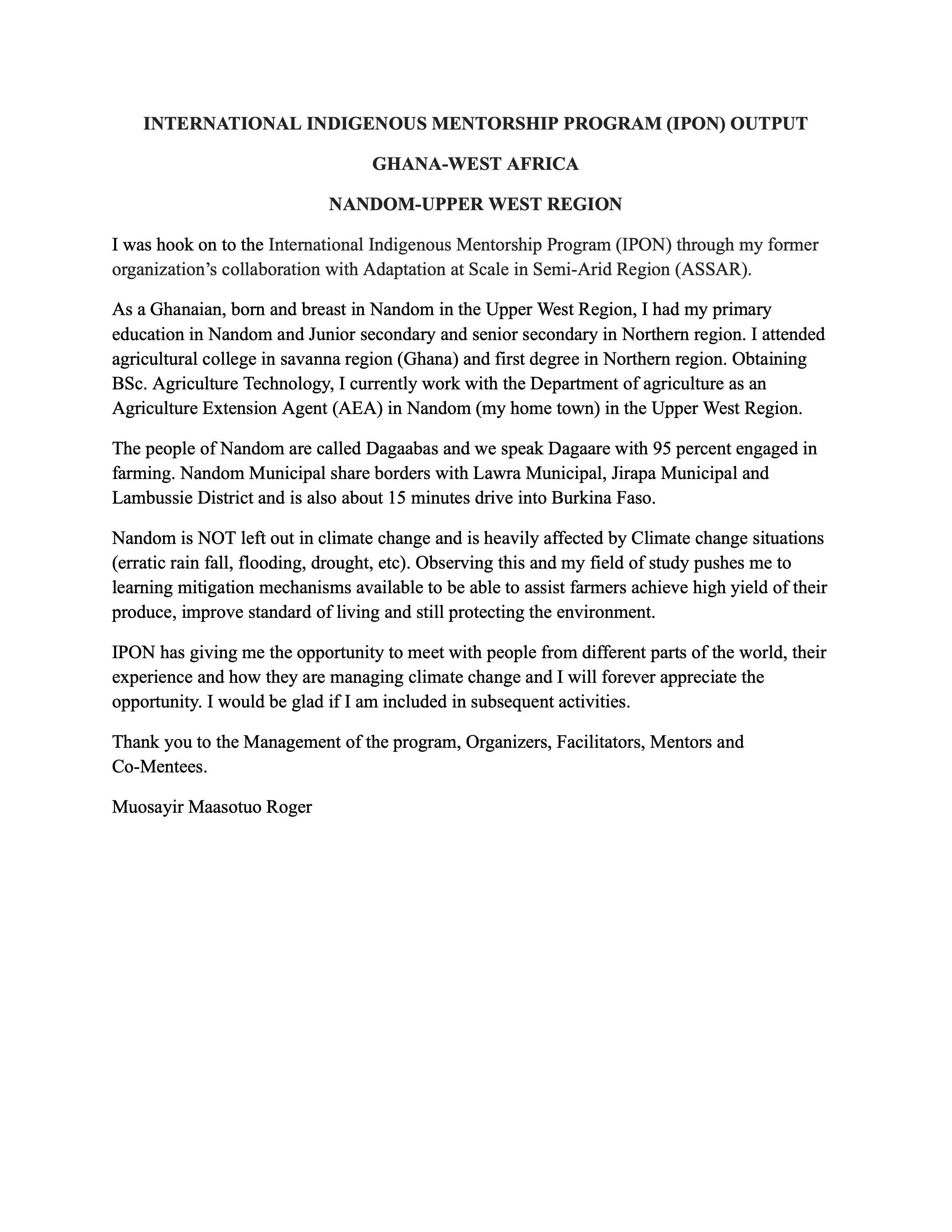
INTERNATIONAL INDIGENOUS MENTORSHIP PROGRAM (IPON) OUTPUT

INTERNATIONAL INDIGENOUS MENTORSHIP PROGRAM (IPON) OUTPUT

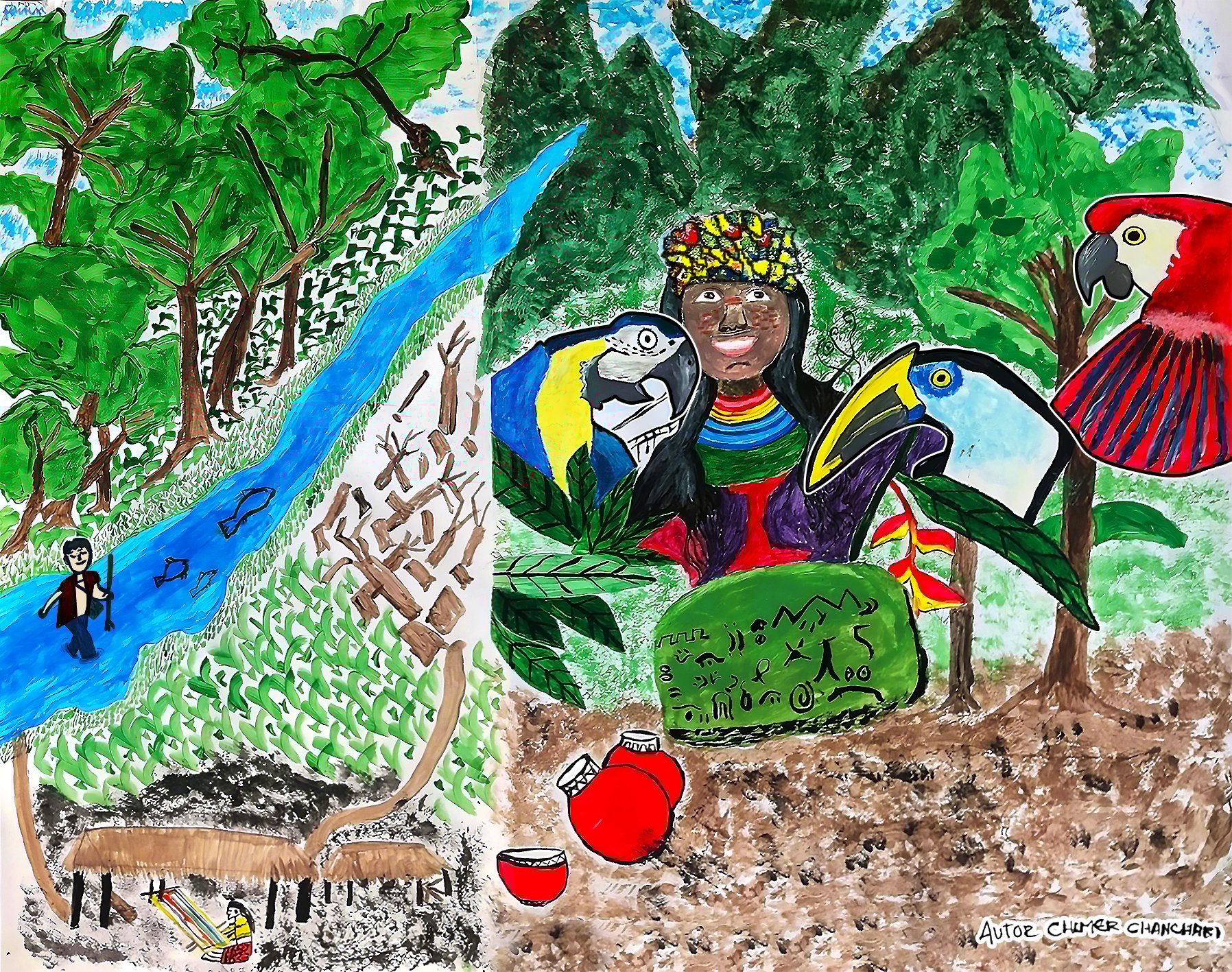
Ma’sharu’sa ya’werinsu shawi ninanu’sake

Nature and painting of the Shawi Indigenous Peoples

In the high mountains, streams and rivers are born, giving water and fish for our consumption. The person in the river represents that we must fish like our ancestors, only with arrow and tarrafa, not with poison because we will destroy all fish.

In the chacra, we plant our food. We do not destroy large quantity of forest, therefore we have pure air to breathe. We should take care of our rivers and forests for next generations.

The Shawi woman is doing crafts, which she learnt from her ancestors; we want that young girls keep our tradition.

Author of the visual work and its narrative reflection: Chimer Chanchari. Original text translated from Spanish to English by Victoria Chicmana. Original painting digilalized by Xiomara Prado

The birds (red macaw, blue macaw and toucan), and the setulli flower, show the colourful landscape of the Amazon.

The Shawi woman wears her traditional clothing, with birds feather ornaments for her beauty. The mountains harbour different species of trees and animals.

The kumpanamá stone represents the God of the Shawi ancestors, and it has carved drawings with messages. The jar is the container to prepare traditional drinks such as masato and chicha, and the mocahua is used to serve the drinks.

Mentorship Toolkit

Access the mentorship toolkit and related resources.

Explore program's virtual toolkit